Sanjeev Autoparts
Automotive parts · IndiaCustomised CRM for RFQ management, opportunity tracking, sales analytics and business dashboards.
Customised CRM and dashboard solution
India
Sanjeev Autoparts manufactures automotive components and handles a steady flow of customer RFQs, each covering several parts. In that business an enquiry is not one opportunity — it is as many opportunities as there are parts in it.
Managed in spreadsheets, that distinction disappears. The project rebuilt it: part-wise opportunity tracking, quotation follow-up and forecasting on one platform.
Businesses running Odoo with OdooBots
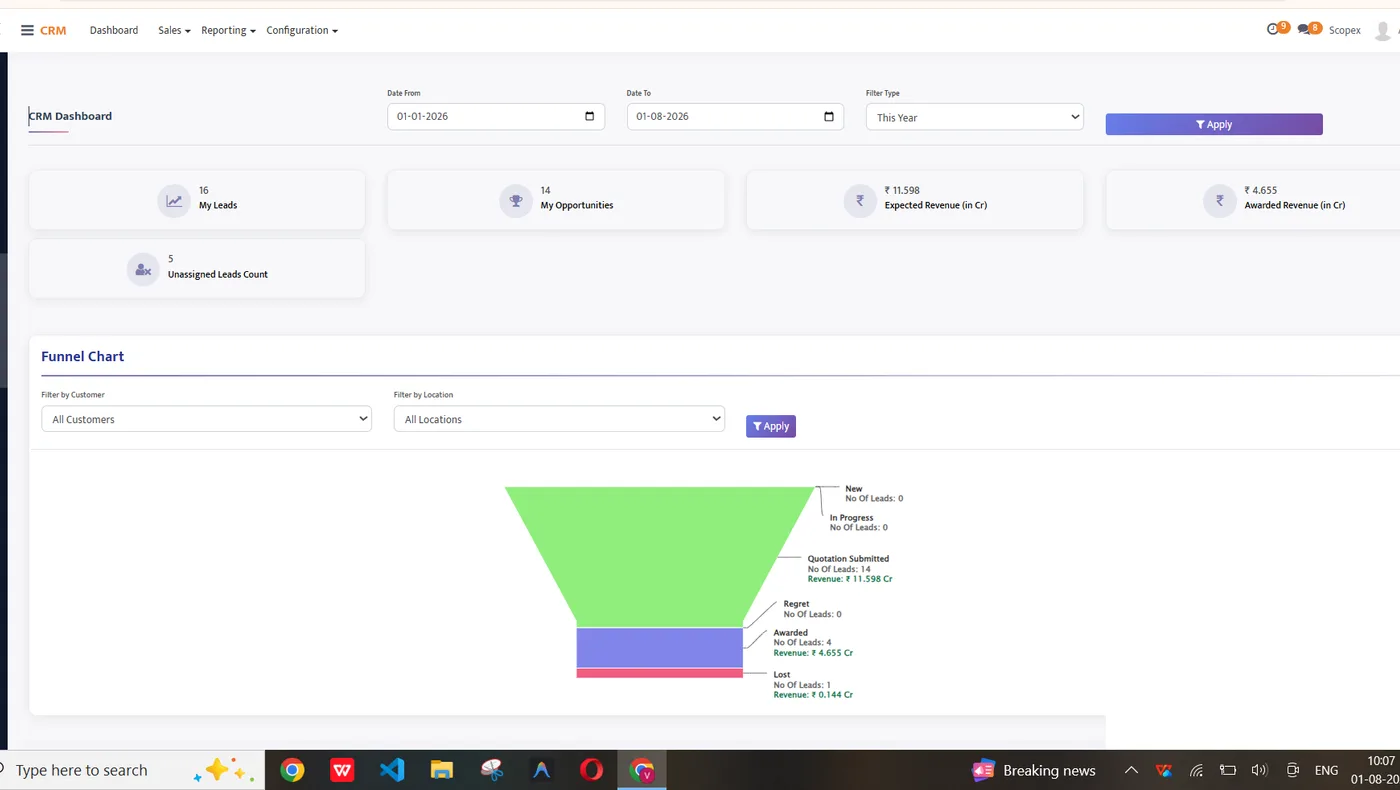
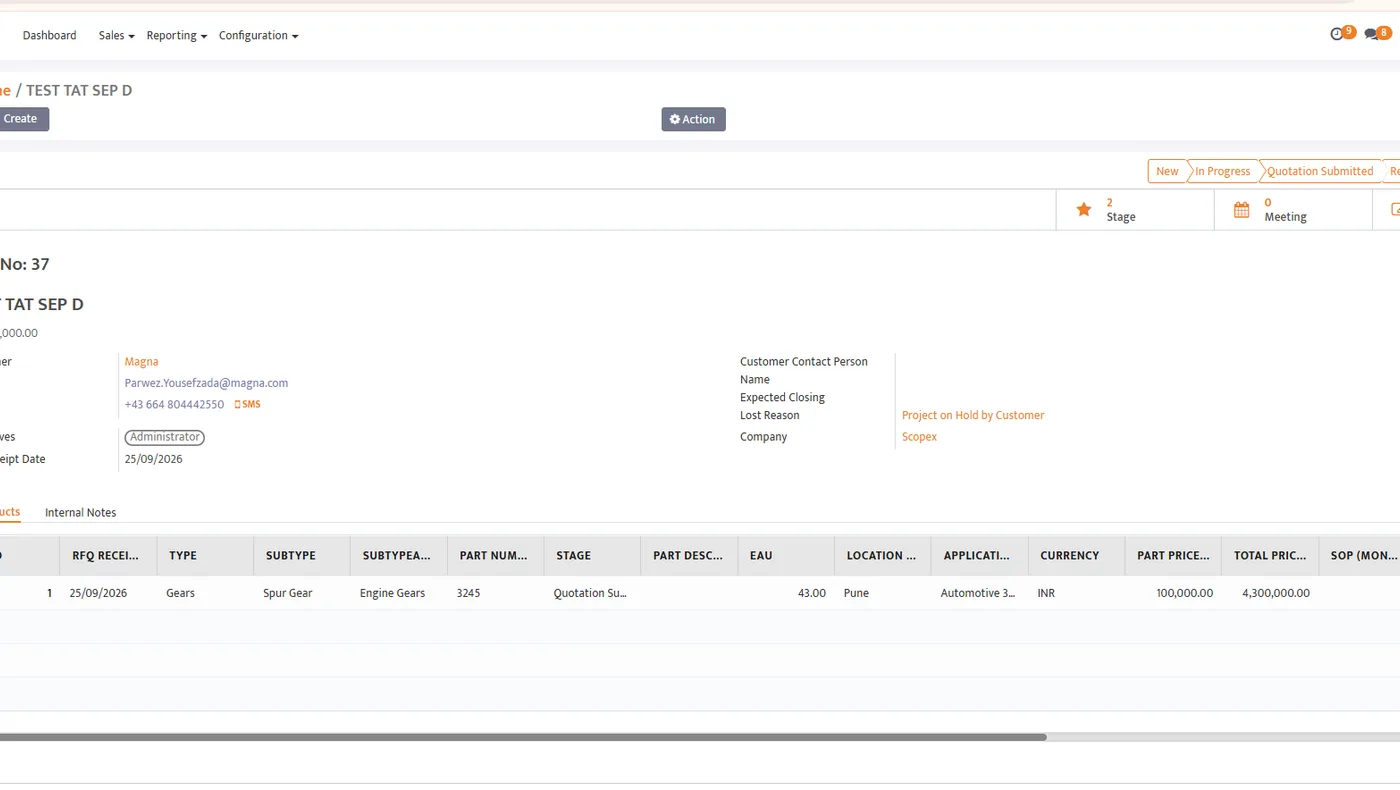
Sanjeev Autoparts runs its RFQ and opportunity lifecycle on a customised Odoo CRM with part-wise tracking. Customer enquiries are captured centrally; each part within an RFQ is tracked as its own opportunity with its own quotation; business forecasting runs on an SOP basis; turnaround time on RFQ response is reported; and dashboards cover business potential and awarded business from the same records the sales team maintains.
Tracking opportunities per part rather than per enquiry is the decision this project turns on. An RFQ covering twelve parts where three are won is not a lost enquiry or a won one, and a CRM that cannot express that cannot forecast.
Taken from the project itself rather than from a capability list.
Customised CRM for RFQ management, opportunity tracking, sales analytics and business dashboards.
Customised CRM and dashboard solution
India
See every Odoo implementation case study, or the full Odoo ERP implementation service.
Customer RFQs, multiple part enquiries, quotation follow-ups, business projections and sales performance were managed through spreadsheets and manual processes. That produced delayed responses, limited visibility and inefficient decision-making — and in a components business, a delayed RFQ response is often the whole reason a part is lost.
Enquiries were logged manually, so response times depended on who saw them and when.
With the enquiry as the unit, an RFQ where some parts were won and others lost could not be reported honestly.
Quotation follow-up depended on individual memory rather than on a dated next action.
Business projections were assembled rather than derived, which makes them slow and hard to revise.
Without turnaround time reporting, the delay customers actually experience was not a number anyone managed.
The implementation digitised the complete RFQ and opportunity lifecycle.
Customer RFQs and enquiries captured in one place, so a request has an owner and a clock from the moment it arrives.
Each part within an RFQ tracked as its own opportunity with its own quotation, so a partly-won enquiry reports as what it is.
Quotation generation and follow-up against each part opportunity, so chasing is driven by the record rather than by recollection.
Business forecasting and projections on a sales and operations planning basis, derived from the pipeline rather than assembled separately.
Turnaround time performance reporting on RFQ response, making the delay a customer experiences into a number the business manages.
Business potential and awarded business reports with management dashboards, read from the same records the sales team works in.
The sales operation now works per part rather than per enquiry, with response time measured and forecasting derived from the pipeline.
What the client reports back, in their terms. We publish no percentages here because the project did not measure any, and a number we cannot stand behind is worth less than one we can.
Centralised capture and part-wise tracking shortened both RFQ handling and quotation preparation.
Customer opportunities became visible at part level rather than hidden inside an enquiry.
Tracking follow-up against each part opportunity improved both the discipline and the conversion reporting.
SOP-based projections derived from the pipeline made planning faster to produce and easier to revise.
Business potential and awarded business reporting gave management current numbers rather than compiled ones.
Teams collaborate on the same records, which removed both manual effort and duplicated data.
What this implementation used, written up properly.
Tell us how many parts a typical RFQ covers and how response time is tracked today. Those two answers shape the configuration, and the diagnosis call is free.