

PV Constructions
Construction · IndiaTask
End-to-end ERP for multi-company management, sales and accounting.
Solution provided
Customised Odoo ERP solution
Location
India
PV Constructions runs several companies. Before this project each had its own system, which meant the same work done several ways and no view across the group without someone building one.
The work was to bring them onto one platform with their books kept properly separate, so a person can move between companies with one login while the accounts stay as distinct as the law requires.
Businesses running Odoo with OdooBots






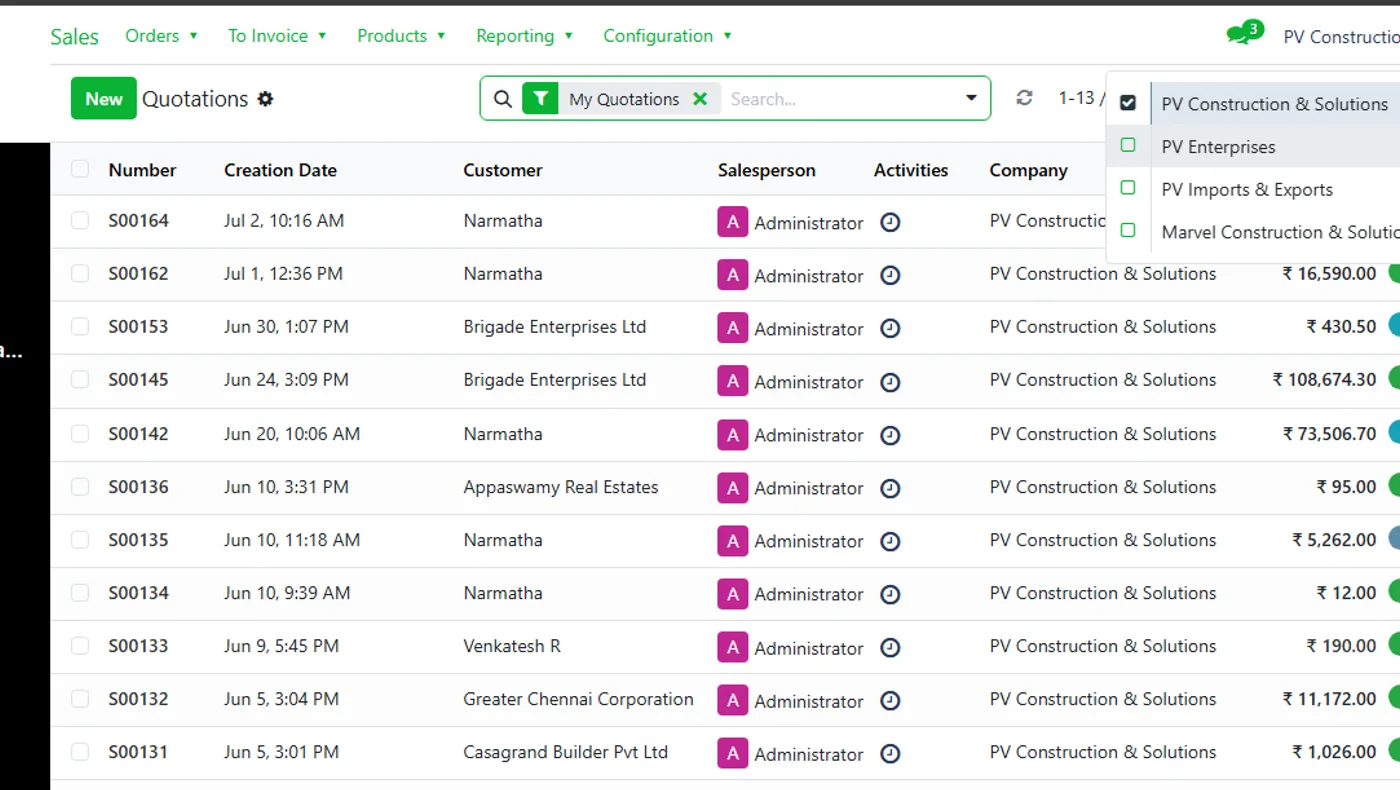
PV Constructions runs several companies on one Odoo system with secure company-wise data separation. A single login switches between companies; sales runs a standardised quotation-to-order workflow across all of them; branded PDF documents and email go out automatically; and accounting covers chart of accounts, taxes, journals, bank management, payment processing and financial reporting per company with a view across the group.
Multi-company is one of the configurations that is cheap to set up correctly at the start and expensive to retrofit. Which records are shared and which are strictly separate has to be decided before the first transaction is posted.
Taken from the project itself rather than from a capability list.
End-to-end ERP for multi-company management, sales and accounting.
Customised Odoo ERP solution
India
See every Odoo implementation case study, or the full Odoo ERP implementation service.
Managing several companies through separate systems created administrative overhead, inconsistent processes and limited visibility across the business. The group needed one platform that could manage multiple companies securely, automate sales workflows, generate professional business documents and maintain accurate financial records with statutory compliance.
Separate systems mean separate logins, separate processes and separate versions of the same master data.
Without a standard workflow, a figure from one company did not mean the same thing as the same figure from another.
Branded quotations and business documents prepared by hand are slow and inconsistent between companies.
Any view across the companies had to be built from exports rather than read from a system.
Statutory requirements handled separately in each system multiplied the same effort across the group.
The implementation covered multi-company structure, sales and accounting together, because the three decide each other.
Several companies in one database with secure company-wise data separation, so each set of books stays as distinct as it needs to be.
One login with seamless switching between companies, so a user working across the group does not maintain several sets of credentials.
A standardised quotation-to-sales process applied across all companies, so the same stage means the same thing wherever it is reported.
Automated email communication and branded PDF generation, so what reaches a customer is consistent regardless of which company sent it.
Chart of accounts, taxes, journals and bank management configured per company, with payment processing and financial reporting on the same structure.
Reporting per company and across the group, read from live records rather than assembled from exports at month end.
The group now runs on one platform with properly separated books, one standard process and reporting that works both per company and across the group.
What the client reports back, in their terms. We publish no percentages here because the project did not measure any, and a number we cannot stand behind is worth less than one we can.
Several companies managed from one platform rather than from several systems with their own habits.
A properly configured chart of accounts, taxes and journals per company improved both accuracy and compliance.
Real-time reports replaced month-end assembly, so the group position is read rather than built.
Branded PDFs and automated email made customer-facing communication consistent across the companies.
The same process in every company means figures are comparable and training transfers between them.
Adding another company to the structure is configuration rather than another system.
What this implementation used, written up properly.
Tell us how many companies you run and whether they share customers or stock. Those two answers decide the structure, and the diagnosis call is free.