

NEXG
Construction & projects · IndiaTask
End-to-end ERP for BOQ management, project execution, procurement, billing and financial control.
Solution provided
Customised Odoo ERP solution
Location
India
NEXG delivers interior design, fit-out and construction projects. That work begins with a bill of quantities and ends with a certified bill, and in between sit procurement, subcontractors, site execution and a budget somebody has to defend.
All of it ran in spreadsheets. The project replaced them with one chain from BOQ through to invoice, with the budget visible while the job is still running.
Businesses running Odoo with OdooBots






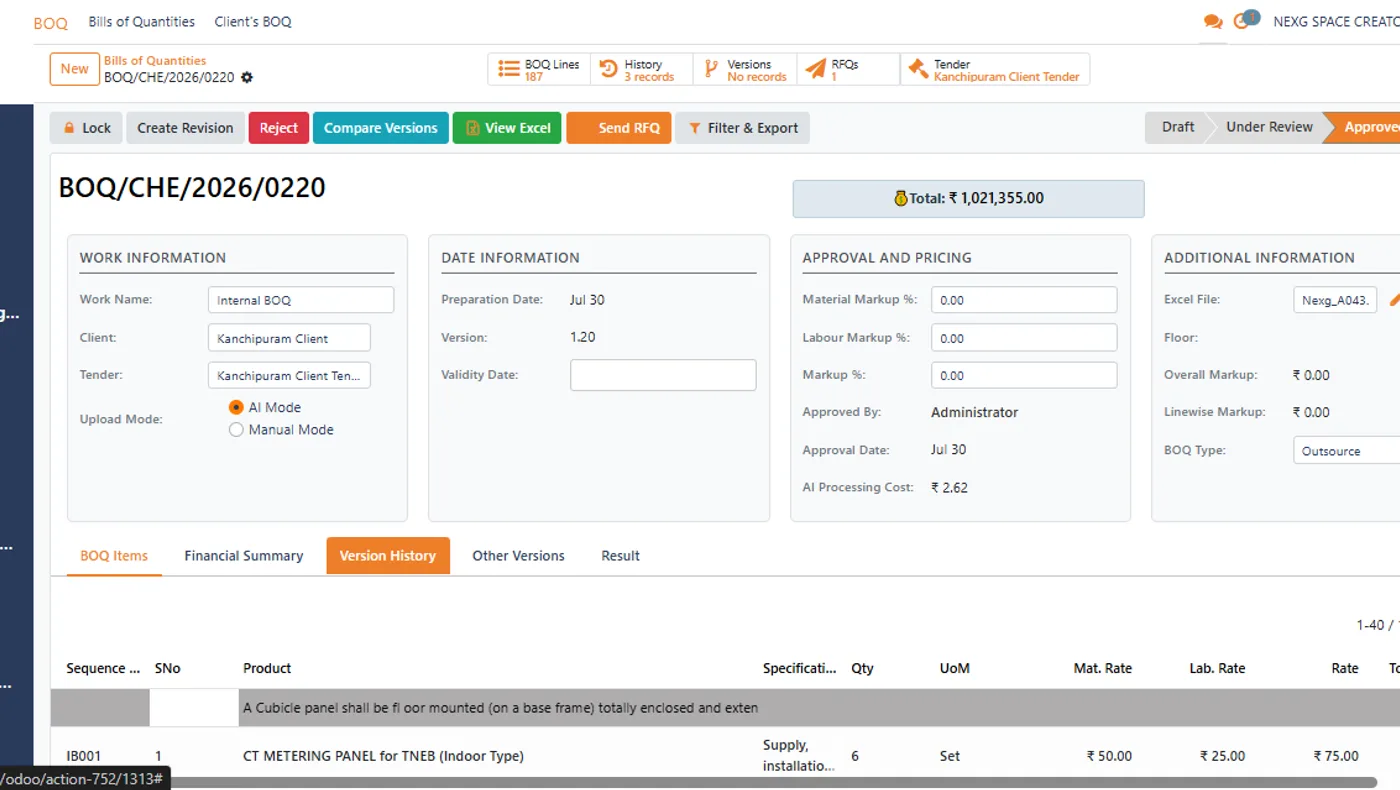
NEXG runs the whole project lifecycle on a customised Odoo ERP, from importing a BOQ to billing a milestone. Excel BOQs are imported with automated data extraction; versions, approvals and revisions are controlled; tenders and quotations become sales orders; approved sales create the project and its tasks automatically; material requests drive RFQs and vendor comparison; stock, purchase orders, deliveries and GRN are tracked; subcontractor work orders are billed; and project budgets, milestone billing, MIS reports and executive dashboards run on the same records.
The decisive piece on a project business is not the BOQ import, impressive as it is. It is that the budget and the actual cost sit on the same project, so a job can be corrected at seventy per cent complete rather than explained at the end.
Taken from the project itself rather than from a capability list.
End-to-end ERP for BOQ management, project execution, procurement, billing and financial control.
Customised Odoo ERP solution
India
See every Odoo implementation case study, or the full Odoo ERP implementation service.
BOQs, project planning, procurement, material requests, vendor comparisons, site execution, subcontractor billing and customer invoicing were all handled in spreadsheets. That created operational delays, limited visibility and reduced cost control — the three problems that compound each other on a project business.
Every project began with an Excel BOQ that had to be read and re-entered before anything could be planned or procured against it.
Without version control and approvals on the BOQ, which revision a project is being executed against becomes a question rather than a fact.
A won sale did not produce a project and its tasks, so the handover between sales and delivery was manual and lossy.
Material requests, RFQs and vendor comparisons happened outside any system, so cost control depended on whoever was doing the buying.
With costs gathered after the fact, project profitability was known when the project ended rather than while it could still be influenced.
The implementation connected estimation, projects, procurement, finance and reporting into one platform.
AI-assisted Excel BOQ import with automated data extraction, so a project starts from the client’s own schedule without it being re-keyed line by line.
Version control, approvals and revision management on the BOQ, so which revision is being executed and billed against is a fact rather than a question.
Tender, quotation and sales order management, carrying a won bid into delivery without the commercial detail being re-entered.
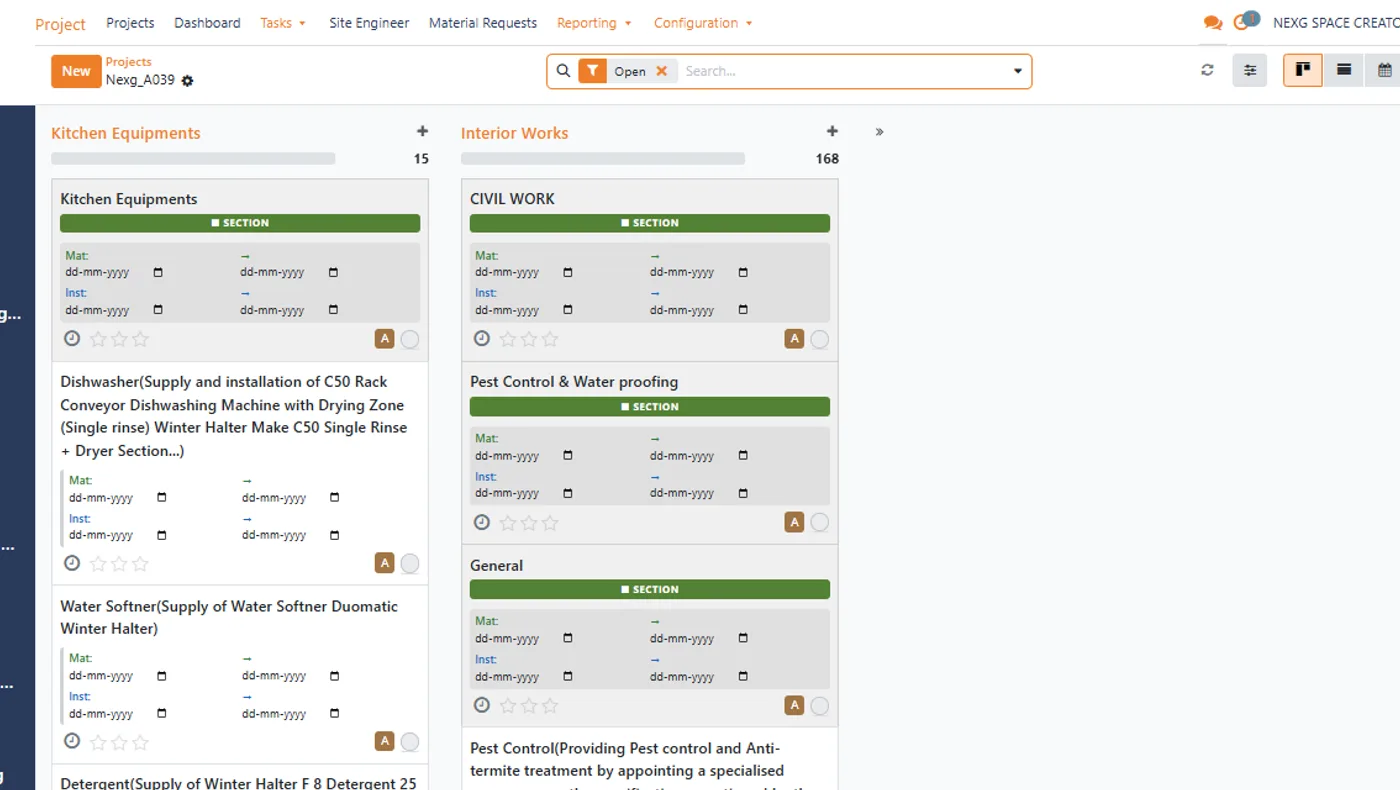
Approved sales creating the project and its tasks automatically, which removes the handover gap between winning work and starting it.
Material requests, procurement, RFQs and vendor comparison, with stock validation, purchase orders, deliveries and GRN all recorded against the project.
Subcontractor work orders and billing, project budgeting, milestone billing, MIS reports and executive dashboards on one set of records.
A project now runs as one chain from the client’s BOQ through procurement and execution to the milestone invoice, with the budget alongside the actual cost throughout.
What the client reports back, in their terms. We publish no percentages here because the project did not measure any, and a number we cannot stand behind is worth less than one we can.
Material requests, RFQs and vendor comparisons in one system improved both transparency and cost control on buying.
Budget and actual cost on the same project made profitability something management watches rather than discovers.
Workflow automation removed the re-entry between BOQ, project, procurement and billing.
Sales, project, purchase and finance teams work from the same records rather than exchanging spreadsheets.
MIS reports and executive dashboards read live data, which makes decisions timely rather than retrospective.
The same structure carries additional projects without additional spreadsheets.
What this implementation used, written up properly.
Tell us whether your BOQs arrive as spreadsheets and how you bill milestones today. Those two answers shape the project, and the diagnosis call is free.